
The Kingdom of Tufas
Kalmynos History
Over the past two decades, Kalymnos has established itself as a major destination for sport climbing. Located in the southeastern Aegean Sea within the Dodecanese archipelago, this mountainous island—roughly 20 km long—possesses a specific history and extensive climbing possibilities.
Historically oriented toward the sea and known for its sponge divers, whose trade shaped the local economy and identity, the island experienced a transition in the late 1990s. The development of high-quality limestone cliffs transformed this arid landscape into a exceptionnal climbing area.
Today, Kalymnos features nearly 4,000 routes, offering a variety of styles from vertical walls to caves with tufas. Centered around the village of Massouri, facing the islet of Telendos, the international climbing community coexists with local life.
Climbing Styles and Grades
While Kalymnos is famous for its massive overhangs, tufas, and three-dimensional climbing, the island offers a much richer geological diversity. Climbers will find numerous slabs, vertical walls, and overhangs of varying steepness.
This same variety applies to the holds: alongside the iconic tufas, blobs, and stalactites, there are many technical routes on crimpy and pocketed walls. Furthermore, this diversity extends to pitch length, ranging from explosive 15-meter routes to superb 50-meter journeys.
There is something for every taste and level, as the vast majority of routes are in the 5th and 6th grades. The 7th grade is also well-represented, comprising nearly a quarter of the routes. In the 8th grade, things are slightly more complex: while there are theoretically over 200 routes graded 8a and above, the practical choice is somewhat limited between ultra-polished classics and routes that are rarely repeated.
Sunset over the historic Odyssey sector. This highly popular crag offers over a hundred routes in every possible style, including several absolute gems—particularly in the 7th grade.
Kalymnos Climbing Trips
Anna and I have been visiting Kalymnos for over ten years, and our passion for it remains unchanged. Of course, we return for the exceptional routes and climbing styles that are nearly unique in Europe, but there is so much more to it.
Once the climbing day is over, with smiles on our faces and tired bodies, the magic of Kalymnos continues through its beaches, cafés, fishing boats, and the sight of happy climbers wandering about.
Climbing in Kalymnos is about the setting, the atmosphere, and the deep connection between the island, its people, and the climbing community. It is a rare alchemy that is hard to find anywhere else.
Where to climb in Kalymnos?
Like the majority of climbers, we began by exploring the historic and most popular sectors of Kalymnos: Arhi, Odyssey, Poets, Noufaro, Ghost Kitchen, Spartacus, Grande Grotta, Panorama, Summertime, Sea Breeze, Kastri, Iliada, Jurassic Park, Kalydna, Ivory, Arginonta, Telendos, North Cape, Galatiani, and Sikati Cave.
As time passed and new sectors were developed, we discovered other cliffs: Aghios Mamas, Arginonta Valley, Gerakios, Griffig, Je t’aime, Olympic Wall, Pezonda, Secret Garden, Snake Valley, Symplegades, and Valhalla.
This incredible number of sectors can sometimes be overwhelming, but it allows you to choose where to climb based on weather conditions, your current fitness, the desired climbing style, or approach times.
It also makes it possible to find less crowded crags—especially during the autumn peak season—which offer magnificent, though lesser-known, routes.
The exceptional Sikati Cave. One might assume that such massive overhangs only host extreme lines; however, some of the island’s most beautiful routes in the 7a+ to 7c range can be found right here.
Beyond the Classics: Finding the Best Routes
As we’ve seen, Kalymnos boasts around 4,000 routes, which is incredible… but it makes choosing difficult when time is limited and you want to avoid disappointment.
The natural reflex is to head for the “classics”—those with the most stars in the guidebook or the highest ascent count on 8a.nu. We did the same, but it often means climbing the most polished lines on the island and sometimes even queuing for a turn.
Over time, we have climbed over 600 routes and discovered that there are countless lines across all grades that offer an equally good climbing experience—often less polished and less crowded—than the ultra-classics. The best approach is undoubtedly a mix of must-do classics and hidden gems.
Bolting and Rebolting
The number of climbers who have contributed to the development of Kalymnos is considerable. While it is impossible to name them all, Aris Theodoropoulos has played a fundamental role in the development of climbing in Kalymnos, not only as a route opener but especially through his collaboration with local authorities and by founding various associations and festivals.
The vast majority of routes are well-equipped, with closely or even very closely spaced bolts, and high-quality two-point anchors. This bolting philosophy has contributed to the popularity of climbing in Kalymnos for over twenty years.
New cliffs and routes are regularly opened, while old or damaged hardware is replaced. We owe this to a dedicated community of local climbers and the associations they have created, such as Rebolt Kalymnos.
Following the terrible accident that claimed the life of a Czech climber in March 2026, the municipality of Kalymnos launched a major plan to renovate the existing climbing equipment. Before going climbing, check on the progress of this project and on any crags that may be closed during the rebolting work. Rebolt Kalymnos is also taking part in this effort.
The beach and village of Arginonta. Within this postcard-perfect setting lie several exceptional cliffs with routes ranging from 5 to 8c: Arhi, Balcony Helvetia, Sea Breeze, Arginonta Valley, Arginonta, Summertime, and Nikoleta.
300 finest routes in Greece
Kalymnos, Leonidio, Kyparissi, and Manikia
Anna and I wrote a book about the 300 finest routes in Greece (in French). It covers the four major destinations: Kalymnos, Leonidio, Kyparissi, and Manikia.
Out of the 7,000 routes equipped across these four exceptional sites, we have climbed 1,200 of them—ranging from 6a to 8b—and have ultimately selected the best 300 for this book.
The selection process was challenging and based on specific criteria: the widest possible variety of crags and climbing styles; the quality of the lines and their equipment; a balanced spread of grades from 6a to 8b; a mix of recent sectors and great classics; a sufficient number of interesting routes per crag; and a preference for sectors that are not overcrowded or overly polished.
The first part of the book provides comprehensive information on trip planning: transport, climate, seasons, gear, and an introduction to physical preparation and energy management.
The guide is organized into four comprehensive sections: Kalymnos, Leonidio, Kyparissi, and Manikia—covering a total of 300 routes across 35 crags. For every selected crag, a dedicated chapter provides essential details such as orientation, sun exposure, and climbing style. Particular attention is paid to access, providing GPS coordinates for parking and the cliffs, as well as descriptions, duration, and elevation gain for the approaches.
Each sector presents a selection of the finest routes, ranked by difficulty and accompanied by personal commentary. Finally, we offer suggestions for combining sectors or activities.
The Kalymnos section covers 14 crags and 131 routes.
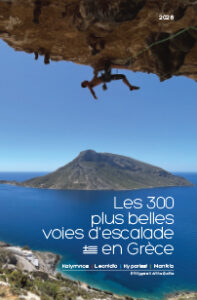

Do Grande Grotta and Panorama still need an introduction? Along with the neighboring sectors of Afternoon, Spartan Wall, and Spartacus, these cliffs have cemented the world-class reputation of Kalymnos.
Kalymnos Information
Recommended Periods
With its classic Mediterranean climate, the best time to visit depends on your personal preferences for temperature and the island’s lively atmosphere. Finding the right balance between warm weather and the seasonal buzz is key to planning your perfect trip.
- Autumn (September to November): This is the busiest period. Conditions are stable, the rock is dry, and the sea remains warm enough for swimming.
- Spring (March to late May): An interesting alternative, often quieter. The island is green, and temperatures are mild (16-25°C), although some seepage may persist after the winter.
- Winter and Summer: Climbing is possible but more restricted (rain and wind in winter; significant heat in summer, requiring early starts in the shade).
Getting There & Around
Several options exist for reaching the island. The most common route, and our personal preference, is to fly to the neighboring island of Kos. From there, a short taxi ride takes you to the port of Mastichari, where ferries depart regularly for a 30 to 45-minute crossing. While direct flights to Kalymnos are available from Athens, they may be subject to delays or cancellations due to strong winds.
Once on the island, scooters remain the most traditional mode of transport. However, rental cars are becoming increasingly popular. If you choose this option, keep in mind that the roads are narrow and parking—especially near popular sectors or in villages—can be quite limited.
Anna provides a sense of scale for the Galatiani cave… and yet, only half of the cliff is visible. There may not be many routes here—nor many crowds—but you will find world-class 40-meter lines.
Accommodation
The island offers a diverse range of accommodation to suit every preference. You will find everything from traditional family-run studios and apartments with kitchenettes—the most common choice for climbers—to more upscale boutique hotels and charming guesthouses.
Massouri and Myrties remain the primary hubs, where many climbers appreciate being able to reach the crags on foot. Beyond the famous Grande Grotta, staying here puts you at the doorstep of sectors like Panorama, Iliada, Kalydna, and Ivory.
For a more peaceful experience, the northern part of the island towards Arginonta, Skalia, and Emporios offers beautiful rental houses and quieter studios. This area is perfect for those targeting sectors such as Arhi, Summertime, Ghost Kitchen, Arginonta Valley, or Secret Garden and Sikati. While these locations offer a more authentic atmosphere, having a vehicle is essential.
Dining & Greek Cuisine
One of the highlights of a trip to Kalymnos is undoubtedly the food. The island offers a fantastic choice of tavernas serving authentic Greek cuisine, known for its fresh, Mediterranean flavors. You can enjoy local specialties such as fresh seafood, sun-ripened vegetables, and the famous Kalymnian honey.
Whether you are looking for a quick souvlaki after climbing or a long, relaxed dinner by the sea, the hospitality is always warm. From the bustling terraces of Massouri to the quiet, beachfront tavernas of Emporios, there is an option for every mood and budget.
Supplies & Services
For your daily needs, Massouri and Myrties offer several convenient mini-markets and local bakeries. However, if you need a wider selection or lower prices, the island’s larger supermarkets are located about 15 minutes away toward Pothia.
This is also where you will find the main gas stations; plan ahead if you are staying in the northern part of the island, as there are no refueling points beyond this area.