Aiguille du Belvédère (2,965m)
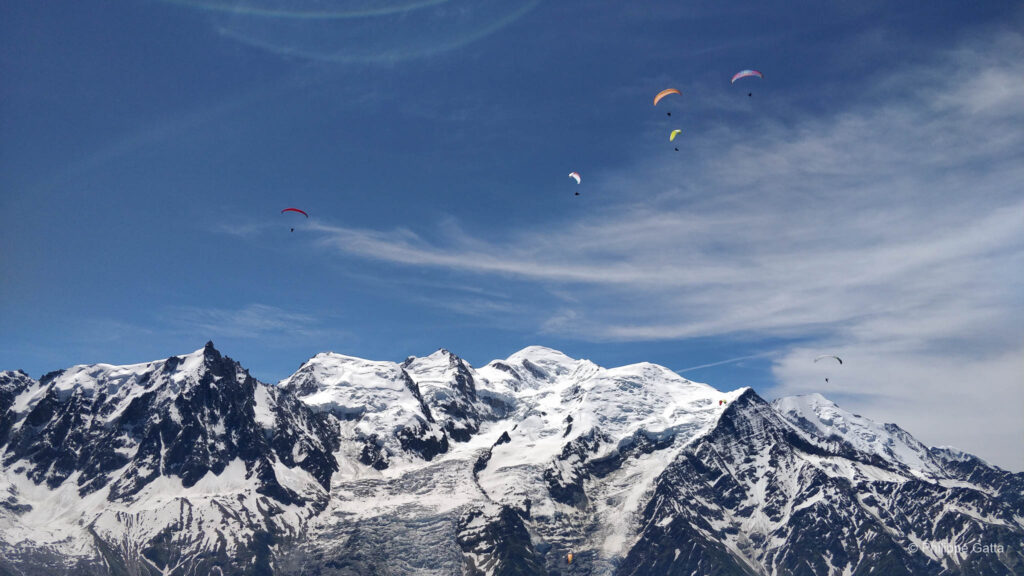
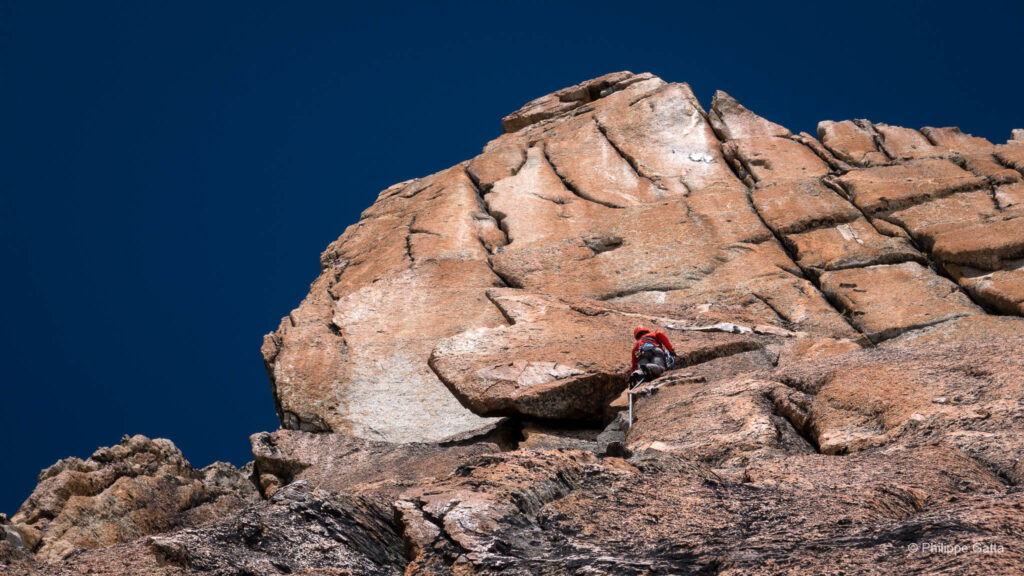
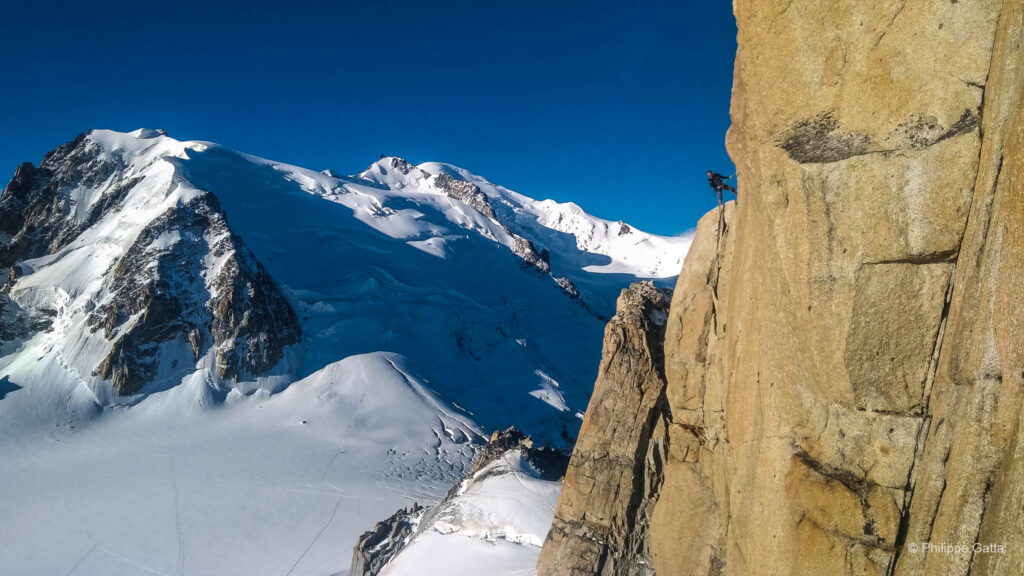
At 2,965m, the Aiguille du Belvédère is the highest peak in the Aiguilles Rouges and offers a superb viewpoint of the Mont Blanc Massif. For climbers, the beautiful South-East face is the primary interest. Standing 300 meters high with steep, compact, and high-quality rock, it hosts several routes, including two Piola lines that I particularly enjoy: Baisers Orageux and especially Mariage de la terre et du vent.
The routes are equipped, but you must “climb” between the bolts. Descent is by rappelling down the routes.
The large central ledge breaks the continuity slightly but provides a chance to catch your breath before tackling the second half of the face.
Approach: The fastest way is to take the Flégère gondola followed by the Index chairlift. Follow the path toward Lac Blanc before heading directly up toward the base of the face, clearly visible from the lake. The final section often holds snow well into the season, so pack light crampons and an ice axe. Allow about 2 hours from the Index. Note that this is also a classic ski touring itinerary. For the return, descend to Lac Blanc and hike directly to La Flégère via the Tour du Pays du Mont Blanc trail (GRP).
Given the approach, the rappels, and the return hike, you need to be fast to complete a route and return before the Flégère gondola closes. Otherwise, you have options: hike down to the parking lot (800m descent on a good path) or sleep at the Flégère refuge. This allows for a second day of climbing on the Belvédère or surrounding peaks like the Aiguilles Crochues, Tour des Crochues, or Glière.
Here is my selection of routes
- Baisers Orageux: ED- / 6c+ / 300m.
- Le mariage de la terre et du vent: ED / 7a / 300m.
Baisers Orageux: ED- / 6c+ / 300m
Baisers Orageux consists of 9 pitches ranging from 6a to 6c+, with sustained climbing in the 6c+ range. The start is identical to Le mariage de la terre et du vent, then the line branches right below the belay. It features a lot of slab climbing, occasionally technical, on rock that is not always very grippy.
While it is obviously a matter of reach, I found that the bolts are often placed high, and you frequently have to pull through the crux just to clip. In the end, it is a beautiful route; despite the lower grades on paper, we found it harder than Le mariage de la terre et du vent.
First Ascent: Michel Piola and Pascal Strappazzon, 1996.
Topo: Les Aiguilles Rouges, Michel Piola.
Le mariage de la terre et du vent: ED / 7a / 300m
Similar to its neighbor, Mariage de la Terre et du Vent consists of 9 pitches ranging from 6a to 7a, with half of the climbing sustained in the 6c+/7a range. Great route.
- Pitch 1 (6a): The first few meters are shared with Baisers Orageux (45.988033, 6.875750), then the route traverses left. It offers easy and straightforward climbing.
- Pitch 2 (6c): A fantastic mix featuring a physical start followed by a technical corner and slabs. A tough pitch.
- Pitch 3 (6c): A superb overhang followed by a delicate slab.
- Pitch 4: Junction on the large central ledge.
- Pitch 5 (6c): Another amazing pitch on a technical wall.
- Pitch 6 (7a): Pure technical wall climbing.
- Pitch 7 (6c+): The technical wall continues; the end of the pitch is harder with one particularly difficult clip.
- Pitch 8 (7a): A technical corner, hard to read, featuring another challenging clip.
- Pitch 9 (6b+): A steep wall where some holds may be loose.
Descent: Rappel down the route.
First Ascent: Christian Hug, Michel Piola, and Pascal Strappazzon (1997–2002).
Topo: Les Aiguilles Rouges, Michel Piola.
Information
Getting There, Accomodation and Climate
Please see the Mont Blanc page for detailed information.
Access: Reaching the Index from Chamonix
Getting to the Index (2,396m) is a two-step process using the Flégère lift system. First, depart from the village of Les Praz (located 2km from Chamonix center, accessible by bus or train) and take the Flégère cable car (gondola). This large cabin takes you up to the Flégère plateau at 1,877m.
Once at the plateau, exit the station and walk a few meters to the Index chairlift. This open-air ride offers stunning views. The top station of the Index is the primary trailhead for the Aiguille du Belvédère and the Lac Blanc.
Guidebooks - Mont Blanc Massif & Aiguilles Rouges
- Aiguilles Rouges & Envers – Michel Piola:
- Aiguilles Rouges 1 & 2
- Envers des Aiguilles
- Mont-Blanc Granite Series – JMEditions (Damilano, Désécures, Laurent)
- Mont Blanc: The Finest Routes – Philippe Batoux (Éditions Guérin)
- Mont Blanc Plaisir & Classique – Marco Romelli (Idea Montagna)
- Sommets du Mont-Blanc – J.L. Laroche & F. Labaeye (Glénat)