Aiguille du Midi
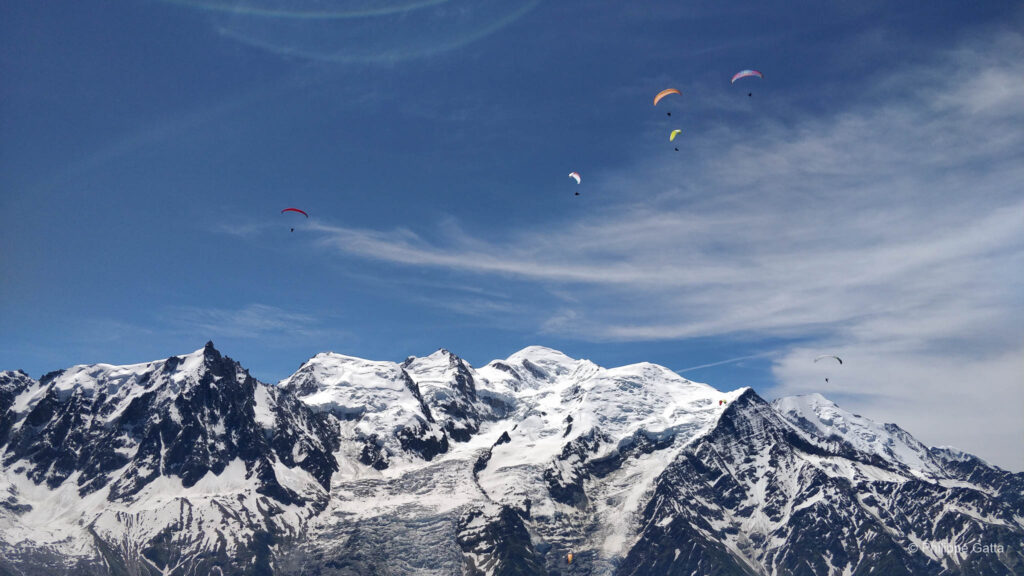
Standing at 3,842 meters, the Aiguille du Midi is the most famous of the Chamonix needles and serves as the gateway to the high-altitude heart of the Mont Blanc massif. Known for its needle-like granite spires and its accessibility via the cable car, it is a place where the worlds of mass tourism and alpinism collide. While thousands of visitors flock to its panoramic terraces to “step into the void,” for climbers, the “Midi” represents something else: a starting point for legendary glacial traverses, Mont Blanc ascent, superb granite cracks, and the spectacular mixed ridges that define the Chamonix experience.
The peak’s unique location offers immediate access to the Vallée Blanche and the Géant Glacier, making it the primary hub for high-alpine training and iconic routes like the Cosmiques Ridge or the South Face’s red granite pillars. Whether you are descending its famous snow ridge (arête) to reach the glaciers below or climbing through the history of pioneers like Gaston Rébuffat on its vertical walls, the Aiguille du Midi remains an essential and majestic landmark for every mountaineer.
Aiguille du Midi Historic Timeline
1818
First Ascent (North Summit)
On August 4, Polish Count Antoni Malczewski, accompanied by Jean-Michel Balmat and five other guides, reached the North Summit of the Aiguille du Midi.
1856
Conquest of the Highest Point (South Summit)
On August 5, Count Fernand de Bouillé, along with guides Alexandre Devouassoud, Ambroise, and Jean Simond, finally reached the South Summit (the highest point), despite the technical difficulties of the era.
1924
The First Cable Car (Les Glaciers)
Inauguration of the first section of the “Téléphérique des Glaciers” for the Winter Olympics. It did not yet reach the summit, but marked the beginning of mechanical access.
1955
Technical Achievement: The New Cable Car
Opening of the current cable car, designed by engineer Dino Lora Totino. At the time, it was the highest in the world—a titanic construction project completed without helicopters.
1956
First Ascent of the South Face (Rébuffat-Baquet)
Gaston Rébuffat and Maurice Baquet opened their famous route on the red granite of the South Face, which remains the most climbed and iconic route on the pillar today.
1982
Parachute Jump Record
Parachutist and BASE jump pioneer Jean-Marc Boivin performed spectacular jumps from the terraces, marking the beginning of the extreme sports era at the site.
Here is my selection of routes
- Mallory-Porter: AD+ / III / 2 / 50°
- Arête des Cosmiques: AD / II / 4a
- Éperon Frendo: D / III / 4 / 5c
- Rébuffat-Baquet (South Face): TD / 6b / II
- Kohlmann (South Face): TD+ / 6c / II
- La Dame du Lac (SW Face): ED- / 6b+ / II
- La Contamine (South Face): ED- / 7a / II
Mallory-Porter: AD+ / III / 2 / 50°
The Mallory-Porter is a historical and classic glacial line on the North Face of the Aiguille du Midi. First climbed in 1919 by George Mallory and H.E.L. Porter, it follows a logical path through steep snow ramps and ice gullies, flanked by impressive granite pillars. While technically straightforward in good conditions, it requires efficient movement and reliable snow cover to safely navigate the glacial terrain and the final exit slopes. Elevation Gain: ~1,000m from the Plan de l’Aiguille.
Skiing Note:
Historically a mountaineering classic, the Mallory-Porter is increasingly popular for steep skiing. With sustained slopes of 50° to 55° and mandatory rappels depending on the snowpack, it is one of the most visible and sought-after “extreme” descents in Chamonix. It demands perfect stability and absolute edge control, as the exposure over the North Face cliffs is significant.
During a training phase with Pascal, we climbed the Mallory four times in six days. By the fifth time, I called it quits, but he went on to climb it twice more with Valentine…
Arête des Cosmiques: AD / II / 4a
The Arête des Cosmiques is the most famous mixed ridge in the massif. Its proximity to the Aiguille du Midi cable car makes it an essential classic, offering an exceptional effort-to-reward ratio. This aesthetic line follows the rocky crest that separates the North Face from the South Face, providing panoramic views of the Chamonix valley on one side and the vast glacial basins of the Mont Blanc range on the other.
The route involves a mix of snowy crests, delicate rappels, and short technical rock steps and mixed climbing. It ends directly onto the platforms of the Aiguille du Midi station.
A classic link-up consists of climbing the Arête à Laurence, topping out directly on the terrace of the Refuge des Cosmiques. After a quick “café gourmand,” you continue straight into the Arête des Cosmiques to finish the day.
In recent years, the route has been significantly affected by the melting of permafrost and glacial recession. Some sections of the ridge have become more unstable, with increased rockfall risk in mid-summer, while the famous snow crests are thinning, sometimes revealing delicate slabs of rock that were previously covered.
Éperon Frendo: D / III / 4 / 5c
The Éperon Frendo is a North Face classic that stands out for its elegance and variety. Unlike many other routes on the Midi, the Frendo offers a distinct two-part challenge: a long, technical rock buttress followed by a spectacular snow and ice ridge that leads directly to the upper slopes of the Aiguille.
The first half of the route involves roughly 500 meters of rock climbing on solid granite, with the technical crux (5c) found in the lower and middle sections. As the rock tapers off, the terrain transforms into one of the most iconic snow arêtes in the Alps—a narrow, curving “S” ridge. Depending on the season, this final section can range from soft snow to hard black ice, requiring expert crampon work (up to 70°-80° in the final exit couloirs).
Modern Status:
Climate change has made the Frendo increasingly technical. The final ice slopes have become steeper and “leaner” as the snow cover disappears earlier in the summer. It is now best approached as a late spring or early summer objective to ensure the upper ridge remains a classic snow climb rather than a demanding undertaking on bare, brittle ice.
Rébuffat-Baquet: TD / 6b / II
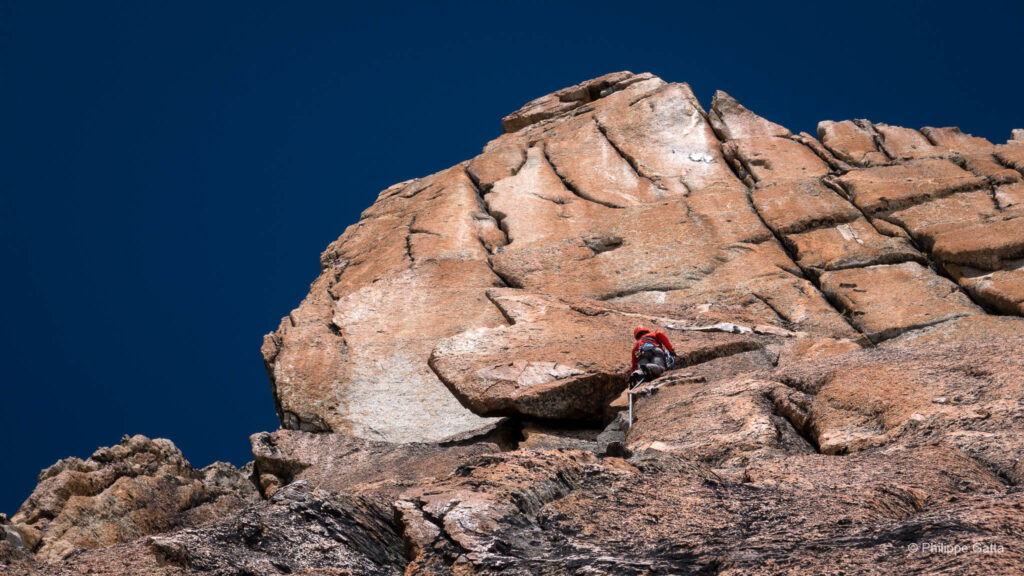
The Rébuffat-Baquet is a masterpiece of alpine rock climbing. Opened in 1956 by the legendary Gaston Rébuffat and Maurice Baquet, it tackles the sun-drenched South Face of the Aiguille du Midi. The route is famous for its exceptional orange granite, perfect cracks, and its position—suspended directly above the Géant Glacier with a finish that brings you onto the very terraces of the cable car station.
The climbing is a pleasure: athletic cracks, delicate slabs, and the famous “S-crack” pitch. While the technical crux is rated 6a, the high altitude (starting at 3,500m) and the thin air add a layer of physical challenge. Despite its popularity and occasional crowds, the quality of the granite remains outstanding, making it a classic objective in the Massif.
To be avoided early in the season when snow remains on the ledges, as it poses a significant risk of ice fall.
Kohlmann: TD+ / 6c / II
The Kohlmann route is probably less well-known than the Rébuffat but equally enjoyable in my opinion. It is a short route, easy to find, featuring good granite with climbing mostly in corners. Opened by P. Kohlmann, B. Mevel, G. Dassonville, and M. Bréban in 1960.
Watch out for potential rockfall from the couloir on the right during the approach and the first few pitches. Make sure to check the current conditions of the route before setting off.
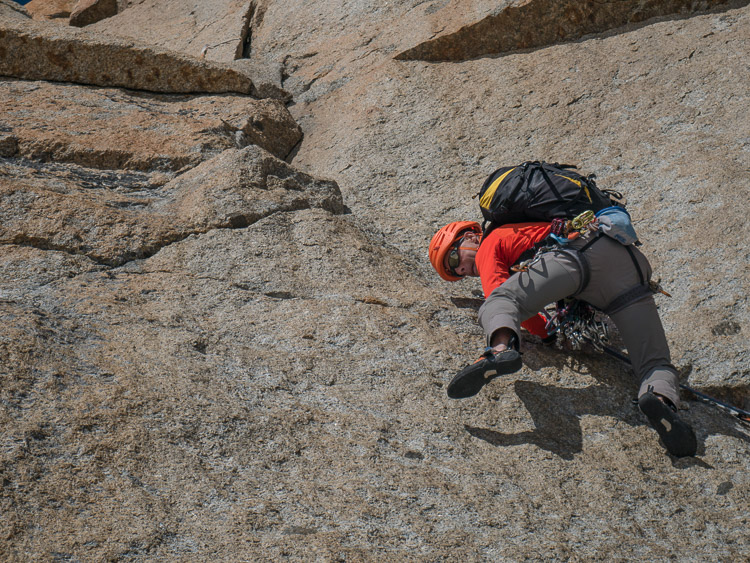
Pitch 5, the 6c crux, involves a technical traverse on crimps. (Photo on the right from M. Baduel)
La Dame du Lac: ED- / 6b+ / II
La Dame du Lac is another beautiful line on generally excellent rock. The opening pitches are superb, particularly the 2nd and 4th. The 5th pitch can be tricky to find, and there is a common tendency to drift into the neighboring route “Quand Yannick s’en mêle.” However, the finish becomes more logical again, climbing on beautiful granite. Gaétano and Romain Vogler opened La Dame du Lac in June 1982.
Warning: Be vigilant regarding rockfall risks during the approach march and while accessing the first pitch.
La Contamine: ED- / 7a / II
La Contamine is one of the most beautiful routes on the Aiguille du Midi and, more generally, another superb line for André Contamine (opened in 1957 with Charles Bozon, Jean Juge, and Pierre Labrunie).
Don’t be fooled by the modest grades—”it’s real climbing!” The 4th pitch (6b+) is magnificent, where a double rack of cams will be most welcome. The 7a pitch is more of a “bouldery” crux on crimps, which is easier for taller climbers. Note that it is possible to traverse into the Kohlmann dihedral before reaching this pitch.
Information
Getting There
Chamonix-Mont-Blanc is centrally located in the Northern French Alps, near the borders of Switzerland and Italy. Its accessibility is a primary factor in its status as a major mountaineering hub, with established transport links for both international and regional travelers.
By Air: The primary international gateway is Geneva Airport (GVA) in Switzerland, located approximately 88 kilometers from Chamonix. Numerous airlines operate year-round flights from major European and international cities. From the airport, several professional shuttle services provide direct transfers to the Chamonix Valley, with a travel time of roughly 1 hour and 15 minutes.
By Road: Chamonix is directly accessible via the Autoroute Blanche (A40), which connects to the broader European motorway network. From Italy, the town is reached via the Mont Blanc Tunnel, which links the Aosta Valley directly to Chamonix. For those traveling from Switzerland, the route typically involves the Martigny – Col de la Forclaz – Col des Montets pass. Within the valley, a comprehensive bus and train network (the Mont Blanc Express) allows for movement between the various lift stations without the need for a private vehicle.
Accommodation and Supplies
Chamonix offers a vast range of accommodation and supply options, serving as the logistical center for mountaineering in the Mont Blanc massif. Due to its popularity, advance booking is recommended, particularly during the peak summer and winter seasons.
Accommodation Options: the town offers numerous hotels, seasonal apartments, and several well-equipped campsites, such as those in the Les Praz, Les Houches or Les Bossons areas.
Supplies and Services: the valley is equipped with several large supermarkets and local specialty food shops for expedition provisions. Chamonix is also a global hub for technical gear; numerous specialized shops offer equipment sales, rentals, and repair services. For the most recent information on mountain conditions and route stability, the Office de Haute Montagne (La Chamoniarde) provides a dedicated information service for climbers and guides.
Climate and Environmental Impact
Chamonix-Mont-Blanc experiences a temperate mountain climate, though the valley’s deep topography creates significant local variations. In the town (1,035 m), summer temperatures are generally pleasant, often ranging between 15°C and 25°C, while winters are cold with frequent snowfall and temperatures regularly dropping below 0°C. However, the valley increasingly experiences heatwaves during the summer months, reflecting a broader shift in alpine weather patterns.
The impact of climate change is particularly visible in the Mont Blanc massif. Rising average temperatures have led to a marked acceleration in glacial retreat and the thawing of high-altitude permafrost. This degradation of the “ice glue” that holds the granite faces together has increased the frequency of rockfalls on technical routes and led to greater instability in serac zones. Consequently, traditional climbing routes are becoming more hazardous during the peak summer months of July and August.
These environmental shifts are causing a significant shift in mountaineering seasons. Many classic routes, once considered summer objectives, are now increasingly climbed during the spring or late autumn to benefit from more stable conditions and better snow cover. This “seasonal shift” requires alpinists to be more flexible and to prioritize early-season windows when the high-altitude terrain remains frozen and secure.
Guidebooks - Mont Blanc Massif & Aiguilles Rouges
- Aiguilles Rouges & Envers – Michel Piola:
- Aiguilles Rouges 1 & 2
- Envers des Aiguilles
- Mont-Blanc Granite Series – JMEditions (Damilano, Désécures, Laurent)
- Mont Blanc: The Finest Routes – Philippe Batoux (Éditions Guérin)
- Mont Blanc Plaisir & Classique – Marco Romelli (Idea Montagna)
- Sommets du Mont-Blanc – J.L. Laroche & F. Labaeye (Glénat)