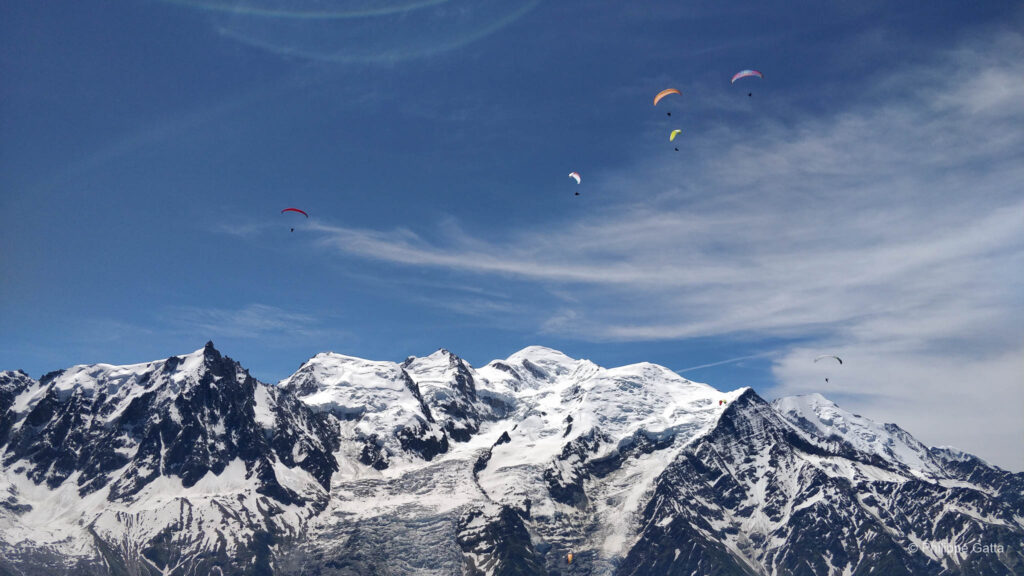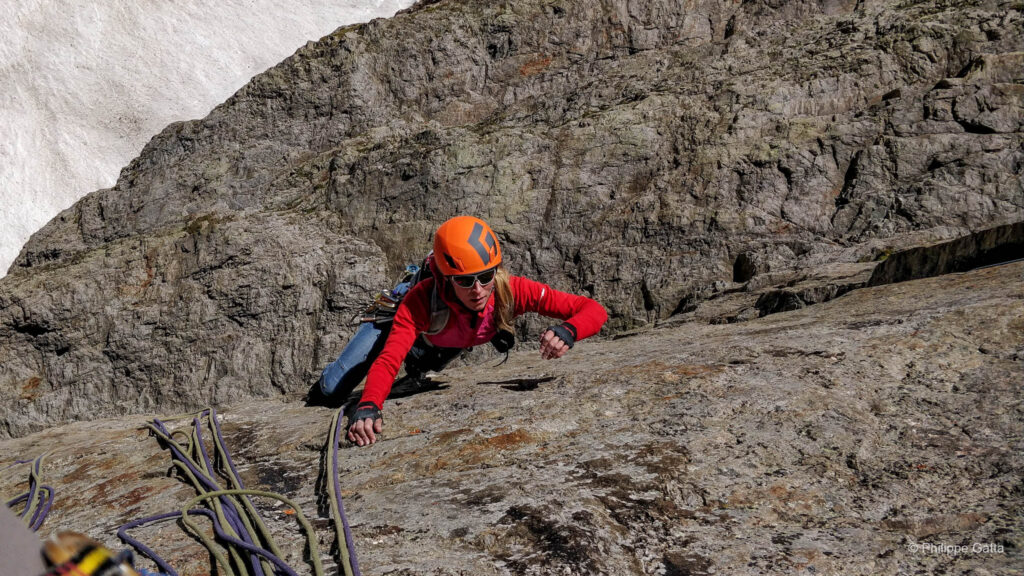
Le Minaret
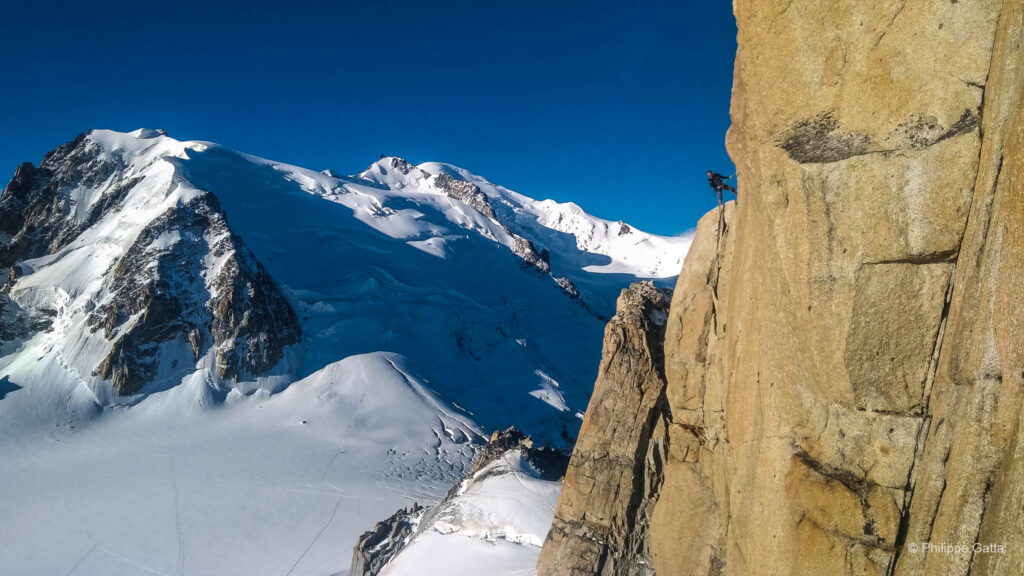
Le Minaret is a discreet summit located on the Arête du Jardin, which begins above the Argentière hut and ends at the summit of the Aiguille d’Argentière. Its superb south face dominates the Améthystes glacier and features four routes on exceptional red granite. The three presented below, sustained in the 6c range, offer magnificent pitches in cracks that are sometimes wide and can be quite challenging.
Le Minaret is a hard-earned summit; the climbing is quite physical, and at over 3,000 meters, the altitude is noticeable. The atmosphere matches the effort, climbing opposite the Droites and the Verte in a grandiose and fairly isolated setting. The setting ensures a memorable experience.
Approach: Reach the Argentière hut (2,760m). From the hut, follow the path between the base of the Arête du Jardin and the Améthystes glacier: 1.2km, +380m elevation gain. Coordinates for the start of Versant Satanique: N45.95154, E7.01401
Descent: Rappel down the routes.
Given the approach and climbing time, it is difficult to complete these routes in a single day. The best strategy is to spend one or more days at the pleasant Argentière hut to take advantage of the immense potential in the area. In this case, hiking up to the hut early on the first day, doing a short acclimatization route above the refuge—such as Vive la jeunesse or Doux Refuge described below—and tackling a route on Le Minaret the following day is a good idea.
Here is my selection of routes
- Versant Satanique: ED / 6c / 300m.
- Voyage en Pierre Sainte: ED- / 6c+/7a / 250m.
- Rasta Metal: ED- / 6c / 270m.
Versant Satanique: ED / 6c / 300m
Versant Satanique is an exceptional and demanding route. Opened by M. Piola and G. Hopfgartner in 1989, the anchors have since been replaced. There are only three bolts on the entire route; carrying a double rack of cams from #0.3 to #4 is highly recommended.
- Pitch 1 (6b): Start in the grey rock (easy) leading to a steep crack in a light grey wall. The last 10m below the anchor form the crux of the pitch.
- Pitch 2 (6a+?): Rated 6a+, but feels significantly harder than the other pitches. Traverse right on the ledge and climb two cracks; traverse left above the first roof. Climb a slab that is difficult to protect toward the second roof. There is a fixed nut; traverse right and climb straight up the overhang. It is physical but with good jugs. The anchor is 2m above the overhang.
- Pitch 3 (5c): Rated 5c, but feels easier. Leave the first anchor on your left and reach the second one a few meters above.
- Pitch 4 (6a+): A fantastic 50m corner. Fun to climb and easy to protect—a truly great pitch.
- Pitch 5 (6b+): Traverse right immediately after the anchor and climb the large cracks. Move back left into the flake/chimney. Climb onto the flake and continue up the crack to the anchor (hard section).
- Pitch 6 (6c): Climb the wide cracks, starting with the one on the left and then moving to the right after the bolt.
- Pitch 7 (6b+): Similar to the previous pitch; wide and physical cracks. Note that there is a bolt on the left before the overhang. The overhang itself is physical but not too difficult.
Descent: Rappel down the route.
Voyage en Pierre Sainte: ED / 6c+ (7a)
Voyage en Pierre Sainte was opened by E. Moro and D. Boroch in 2016. Located just to the right of Versant Satanique, it is very similar in style, featuring two crux pitches on wide cracks. It is slightly harder and stands as a high-quality line. The route consists of 8 pitches; while there are a few bolts where necessary, you should bring two racks of cams from #0.3 to #3 and one #4.
- Pitch 1 (5c): Traverse up and right over easy ground (gullies and corners, often wet), to the right of Versant Satanique, heading toward the red pillar of the second pitch. A steeper crack leads to the ledge and the anchor.
- Pitch 2 (6b): A short pitch heading straight up the red pillar (1 bolt).
- Pitch 3 (6b): Another short pitch continuing up the red pillar; steep at the start followed by a slabby traverse to the right, then easy ground to the top of the pillar. Traverse 10m left to reach the anchor (4 bolts).
- Pitch 4 (6c): A 45m pitch. Follow the crack straight above the anchor and pull through two successive roofs (2 bolts).
- Pitch 5 (6a+): Straight up the wide cracks; Versant Satanique is just to the left. Upon reaching the large flake, traverse right to the anchor (1 bolt).
- Pitch 6 (6c+/7a): 30m. Climb the wide crack above the anchor; sustained and physical (2 bolts).
- Pitch 7 (6c+/7a): 20m. Continue up the wide crack above the anchor; intense and bouldery until you reach the “V.” Build a gear anchor at the bottom of the thin crack.
- Pitch 8 (6a): Climb the thin crack, progressively moving left to reach the final anchor of Versant Satanique.
Descent: Rappel down the line of Versant Satanique.
Rasta Metal: ED- / 6c / 270m
Rasta Metal is located on the far right of the wall, to the right of the Rébuffat–Mazars, and offers sustained climbing on flawless granite.
The route was opened by N. Potard, P. Dudas, and P. Ducroz in 2004. It consists of 8 pitches with a few bolts in place. Gear: Two full racks of cams (#0.3 to #3), one #4, and 2x60m ropes.
Approach: Climb a couloir of loose rock heading up and right, passing the start of the Rébuffat–Mazars to reach the base of the first pitch.
- Pitch 1 (6a+): Rated 6a, but feels like a solid 6a+. Exposed until you reach the thread/lunule (first small roof). A technical and aesthetic pitch. The anchor is on a ledge to the left at the end of the corner.
- Pitch 2 (6a): Start straight above the anchor, then move right (2 bolts). Pass to the left of the pillar and continue to the top. Pass the first sling to reach the true anchor a few meters higher.
- Pitch 2 bis (4): Climb an easy slab for 3m above the anchor, then down-climb a crack to the right toward a couloir. Pass the pillar to reach the anchor behind it. Important: The leader should place gear during the down-climb to protect the second. This pitch bypasses a rockfall-prone couloir to reach the corner of Pitch 3 safely.
- Pitch 3 (6b+): Rated 6b, but feels like a solid 6b+. In my opinion, the hardest pitch of the route. Climb the obvious corner; physical but with some easier sections. Relatively easy to protect.
- Pitch 4 (6a+): Climb the corner; physical and slightly bouldery at the finish, but a shorter pitch.
- Pitch 5 (5b/c): Rated 6a, but likely closer to 5b or 5c. Climb a series of ledges and short walls (45m) to the base of the steep wall above. Note: There is an anchor a few meters up and left—use this on the descent to avoid rope jams.
- Pitch 6 (6b+): Rated 6c, but probably 6b+. Climb straight to the first bolt, traverse to the crack on the left (2nd bolt), and continue up the crack. Pass left of the pillar toward the end (40m). An easy final section leads to the top of the first tower.
Descent: Rappel down the route. Once back at the base of the first pitch, down-climb about 10 meters to reach an anchor. Use this for a final 60m rappel directly to the snowfield, avoiding the loose approach couloir.
Aiguille du Refuge (3,057m)
The Aiguille du Refuge is a small summit located directly above the hut. The approach is very short, taking about twenty minutes. The two routes presented here are approximately 200m long and are equipped for rappelling.
Doux refuge: TD+ / 6b / II / 200m
The route was opened in 2013 by Eric Moro and Gab Ribordy. It features 7 pitches ranging from 4c to 6b. The descent is made by abseil (rappel) back down the line.
Vive la Jeunesse: TD+ / 6c / I / 200m
Vive la Jeunesse offers a mix of cracks, slabs, and overhangs on perfect red granite. Although I personally prefer Doux Refuge—which is slightly easier and more pleasant to climb—this remains a solid line. It consists of 6 pitches and was opened by D. Boroch, E., P., and A. Moro in 2015. The route has a few bolts where necessary; you should bring one rack of cams from #0.3 to #3.
- Pitch 1 (6b): Start on an easy crack/corner, pass to the right of a small gendarme, then tackle the overhang (crux).
- Pitch 2 (6b): The first part is easy up to a ledge, then follow a crack and move left to pull through the overhang.
- Pitch 3 (6c+): Start with technical slabs (bolted) heading toward the left side of the overhang (bolted). After the overhang, climb the vertical crack (Caution: do not head right toward an old anchor). The crack is sustained, occasionally contains grass or mud, and is not particularly easy to protect.
- Pitch 4 (6b+): A physical 6b+ start followed by a beautiful 6a crack.
- Pitch 5 (5c+): An enjoyable and easier pitch.
- Pitch 6: Traverse left to join the final anchor of Doux Refuge.
Descent: Rappel via the line of Doux Refuge.
Information
Getting There, Accomodation and Climate
Please see the Mont Blanc page for detailed information.
Access: Reaching Argentiere hut from Chamonix
From Chamonix, travel approximately 8km up the valley to the village of Argentière (accessible via the “Chamonix Bus” or the Mont Blanc Express train). The Plan Joran gondola departs from the large Les Grands Montets parking area and takes you up to 2,130m.
Check with the refuge (hut) and La Chamoniarde for the best access route, as it can be complicated.
Guidebooks - Mont Blanc Massif & Aiguilles Rouges
- Aiguilles Rouges & Envers – Michel Piola:
- Aiguilles Rouges 1 & 2
- Envers des Aiguilles
- Mont-Blanc Granite Series – JMEditions (Damilano, Désécures, Laurent)
- Mont Blanc: The Finest Routes – Philippe Batoux (Éditions Guérin)
- Mont Blanc Plaisir & Classique – Marco Romelli (Idea Montagna)
- Sommets du Mont-Blanc – J.L. Laroche & F. Labaeye (Glénat)